
Can we test quantum gravity with the Universe?
Quantum gravity attempts to describe the fundamental quantum nature of space and time. It is normally associated with the very early Universe or black holes, where gravity becomes extremely strong. But could traces of this fundamental physics also survive in the Universe today?
In our recent work, we explored this possibility using Group Field Theory, an approach in which our familiar picture of continuous space and time emerges from more fundamental quantum building blocks. Remarkably, the same physics can produce an accelerating Universe and make predictions for how dark energy changes as the Universe evolves.
We compared these predictions with observations that map the expansion of the Universe over billions of years. Some of the models predict that dark energy gently oscillates over cosmic time, and we find that certain oscillations provide a particularly good match to current observations.
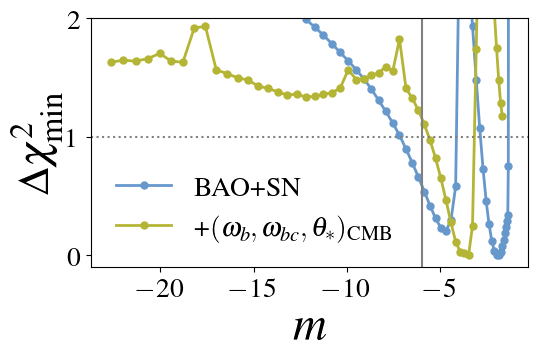
The figure shows an example. The parameter m describes different possible interactions in the underlying quantum theory. The dips show which interactions give the best description of the observed Universe—and illustrate how astronomical observations can potentially tell us something about the most fundamental descriptions of Nature.
This is not evidence for quantum gravity. But it demonstrates an exciting connection: precision measurements of our Universe can begin to test ideas about the fundamental quantum structure from which space and time may have emerged.
Searching for Stress-Relieving Stable Islands
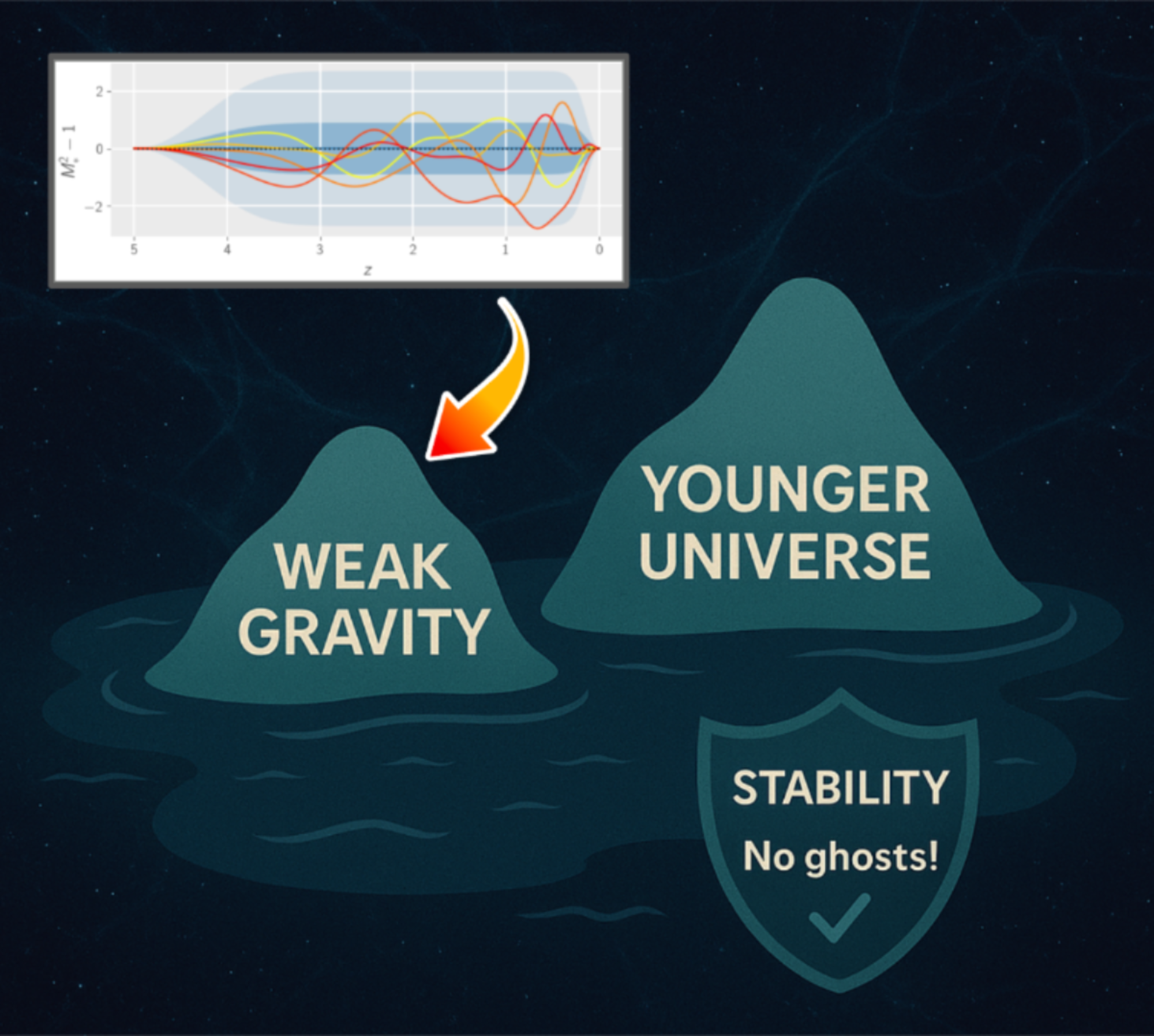
Over the past decade, cosmologists have uncovered a set of puzzling mismatches—“cosmological tensions”—between different ways of measuring the expansion and growth of the Universe. Some observations suggest the Universe is expanding faster than expected, while others show structures growing more slowly than our standard model predicts. One exciting possibility is that gravity itself may behave slightly differently on the largest cosmic scales. But modifying gravity is tricky: most theoretical tweaks make the Universe violently unstable or contain unphysical negative energy states known as ghosts.
In this paper, my collaborators and I have begun a search for rare, carefully balanced “stable islands” in the vast ocean of possible theories—models where gravity is subtly weaker or the Universe evolves slightly differently, yet everything remains mathematically and physically stable and consistent with observations.
To navigate this enormous space of possibilities, we use machine learning to generate and explore thousands of candidate theories that would be impossible to search through otherwise. The goal is an island which can relieve cosmological tensions while remaining ghost-free and well-behaved. These “stable islands” point to intriguing alternatives to the standard model: universes with slightly weaker gravity, or ones that are a bit younger than the conventional picture. While the search is still in its early stages, there may be an island that convincingly tells us that there is indeed new physics shaping the evolution of the cosmos.
11.2025
Do Dark Energy and Dark Matter Interact?
This study tests the idea that dark energy and dark matter—the two mysterious ingredients making up most of the Universe—might be exchanging momentum in elastic collisions, similar to colliding billiard balls on a pool table. This model, called Dark Scattering, while also being an interesting idea to explore, could help explain one of cosmology’s current puzzles: the mismatch between how fast large structures (think clusters of millions of galaxies) appear to grow compared to predictions from the standard model of the Universe which assumes dark matter and dark energy do not interact.
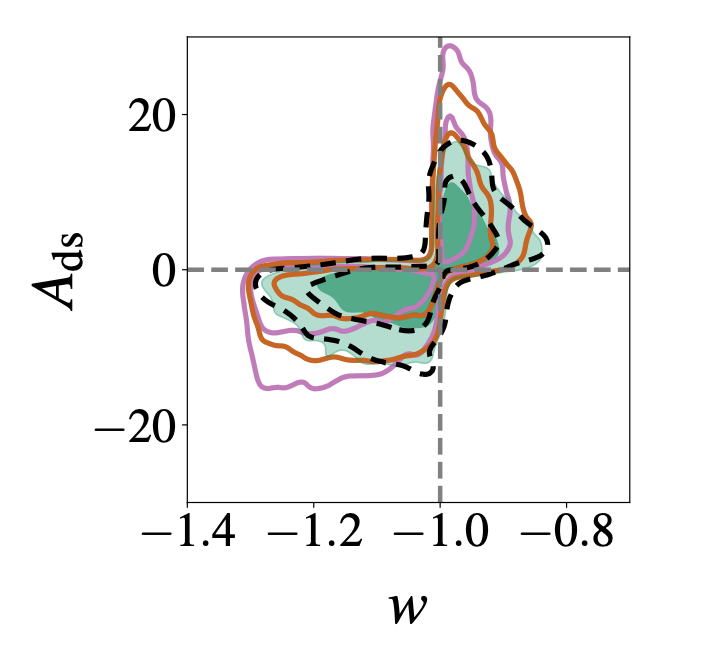
Using data from two major galaxy surveys—the Dark Energy Survey (which measures the images of galaxies that are distorted by cosmic structure) and BOSS DR12 (which uses the 3-dimensional distribution of galaxies in the Universe)—the authors test whether this Dark Scattering interaction could be real. They combine these datasets using advanced statistical tools to place the tightest-ever limits on how strong this interaction could be using galaxies, but find no evidence for the interaction. The image shows the probability of the interaction inferred from the data, with A measuring the strength of the interaction (A=0 means no interaction) and w measuring the behaviour of the dark energy density (w=-1 means it does not change over time). A=0 and w=-1 refer to the standard model of the Universe which is most likely given the data. The different curves refer to slightly different analysis choices.
Using data from two major galaxy surveys—the Dark Energy Survey (which measures the images of galaxies that are distorted by cosmic structure) and BOSS DR12 (which uses the 3-dimensional distribution of galaxies in the Universe)—the authors test whether this Dark Scattering interaction could be real. They combine these datasets using advanced statistical tools to place the tightest-ever limits on how strong this interaction could be using galaxies, but find no evidence for the interaction. The image shows the probability of the interaction inferred from the data, with A measuring the strength of the interaction (A=0 means no interaction) and w measuring the behaviour of the dark energy density (w=-1 means it does not change over time). A=0 and w=-1 refer to the standard model of the Universe which is most likely given the data. The different curves refer to slightly different analysis choices.
The Euclid survey will be able to shed further light on the viability of this idea.
05.2025
Euclid Mission Overview and First Data
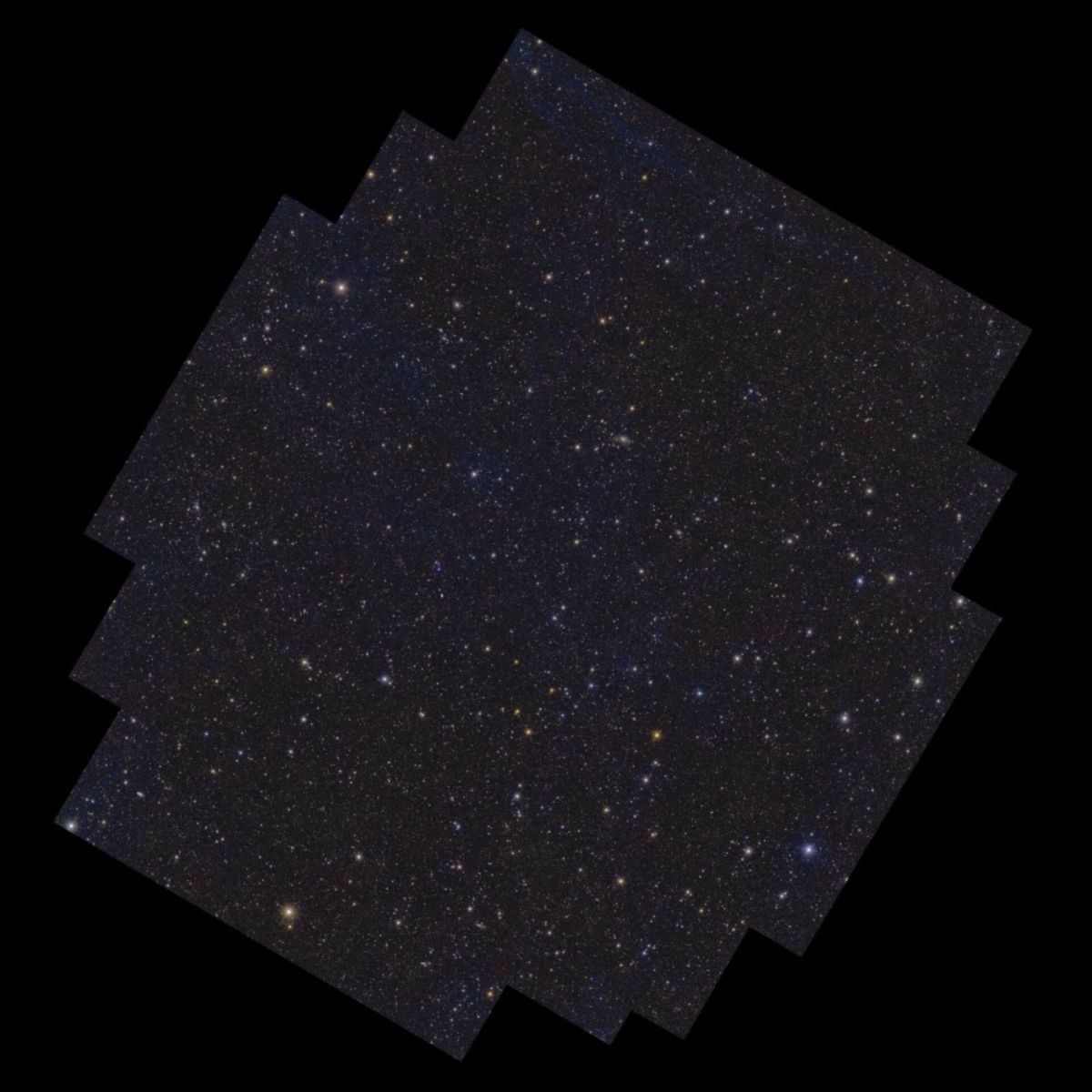
The European Space Agency’s Euclid mission aims to explore the mysteries of dark matter and dark energy—two unseen components believed to make up most of our Universe. By capturing high-resolution images and spectra in visible and near-infrared light across a vast portion of the sky, Euclid will map the distribution of galaxies and cosmic structures over more than half the Universe’s history. This extensive survey will help scientists understand how the Universe has expanded and how structures like galaxies have formed and evolved. This paper gives a complete overview of the mission and its scientific goals. For general updates on the mission, you can check out the ESA page. The photo is one of Euclid's first released images, which shows millions of galaxies, some as far as 10 billion light-years away.
03.2025
Detecting Modified Gravity with Galaxy Lensing
In this paper we show the great potential of upcoming galaxy observations, as those being performed by Euclid, to detect key signatures of gravitational theories that go beyond Einstein's theory of general relativity. Specifically signatures associated with so called 'screening mechanisms'. These theoretical mechanisms ensure that any modification to general relativity is switched off in places like our solar system or the Milky Way - where we know apples fall according to Einstein's and Newton's laws - while still allowing a modification to the gravitational force at much larger distances -where we aren't quite sure if Einstein was right about how, say galaxies, fall into each other.
This work uses galaxy lensing, the distortion in the shapes of galaxies due to gravity, to investigate such screening mechanisms. The analyses performed were only tests, but strongly indicate the potential of Euclid's upcoming data to detect the point where these screening mechanisms kick in and gravity begins to act as general relativity predicts, if it is modified at all of course.
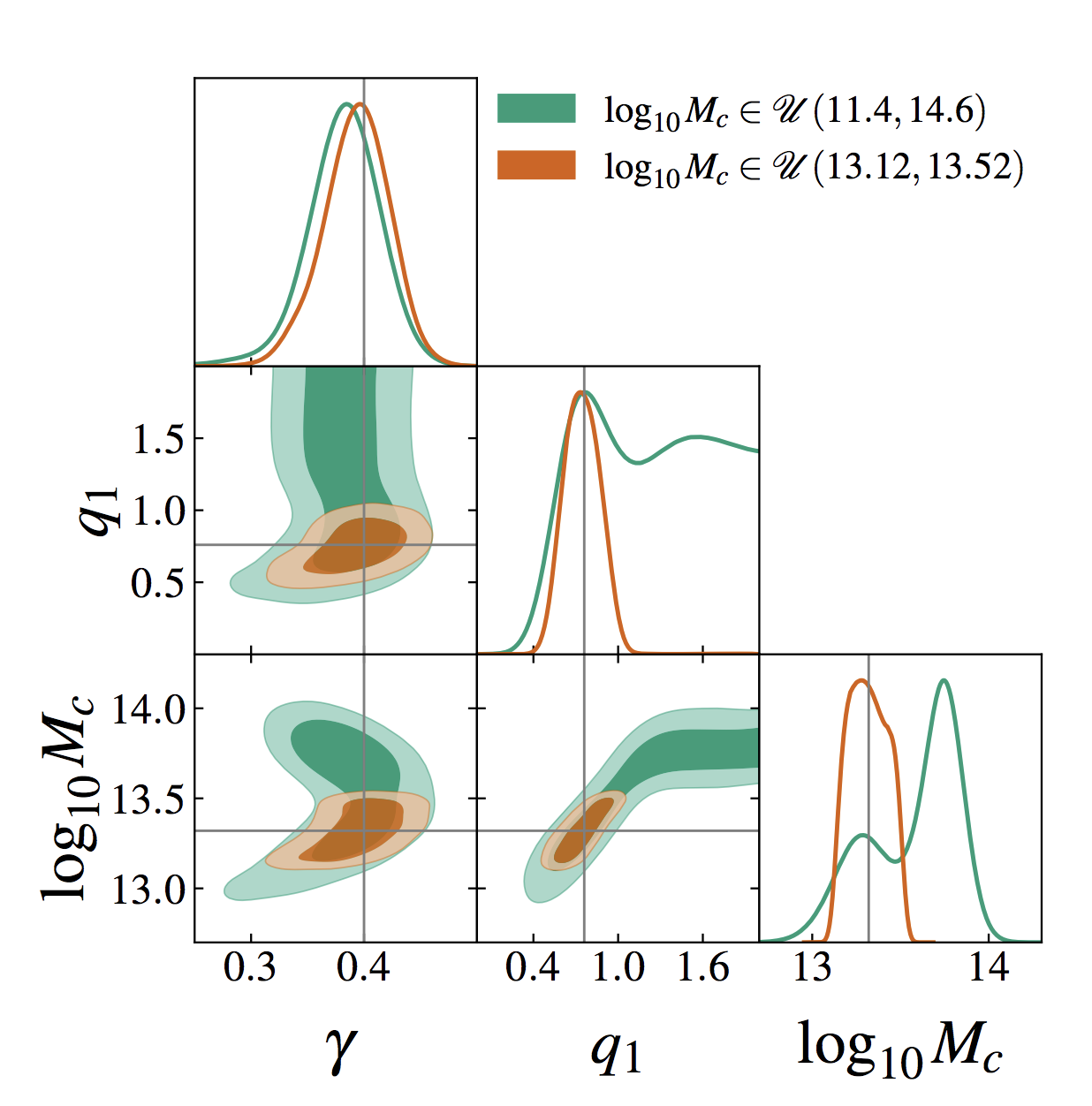
The plot on the left shows the estimated areas in theory space where the Universe is likely to be (if there is a modification to gravity) given the quality of upcoming observations. γ indicates the modification to gravity at very large separations (way larger than our own galaxy's size) and q1 gives the scale at which this modification is switched off .
- General relativity corresponds to a value of γ = 0.55, and a value less than this indicates a stronger gravitational force than expected at large separations.
- As q1 decreases the screening scale becomes very large, while as q1 increases the screening scale becomes very small.
The plot also shows 'log10[Mc]' which governs baryonic effects which give the extent to which astrophysical effects and gas affect the galaxy lensing observations.
What we find is that if we have no information about these baryonic effects, the screening scale is very hard to determine - this scenario corresponds to the green blobs in the plot - q1 is equally likely to have a small value as it is to have a very large value (corresponding to a very small screening scale). Basically we can't disentangle the two effects given the observations.
On the other hand, if we get information on baryonic effects from other observations, such as X-ray observations of groups of galaxies, we can really pin down the screening scale (if it even exists) where modifications to gravity are shut off! This is shown as the orange blobs which show a very narrow range in q1 where we could live.
A detection of q1, like the one shown, with upcoming Euclid data will be absolutely huge: it would indicate strongly that general relativity is not the end of the story when it comes to gravity and the Universe!
05.2024
Classifying the Universe: Part 2
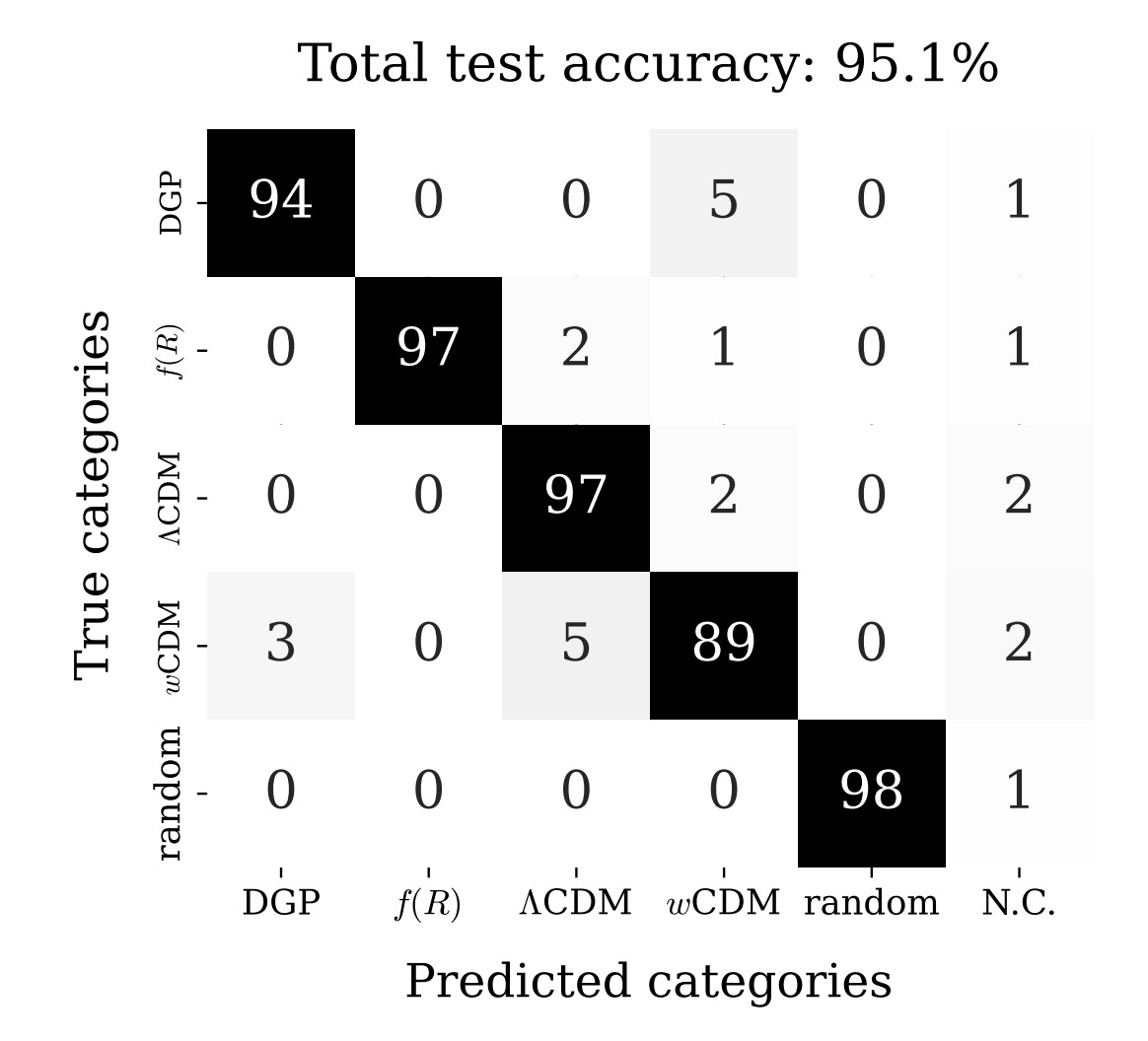
In this paper, we extend the Bayesian Cosmological Network. The study expands the previous version of BaCoN by considering additional cosmic elements like massive neutrinos and the influence of stars and active galactic nuclei - the super massive black holes lying at the heart of galaxies. We improved how the network handles errors and tested it with different cosmic models. The improved network correctly identified different models of our Universe about 95% of the time, showing that this method could significantly enhance our understanding of the Universe through upcoming large-scale galaxy observation missions.
The next step would be to extend BaCoN to be trained on the actual galaxy observables, in particular what is called the cosmic shear spectrum - the two point correlation of the galaxy distortion or shear field. These distortions are caused by the bending of light by the cosmological matter between us and the galaxies we observe, and the distortions themselves contain an abundance of information of how the Universe evolved and its energy content today.
The image to the right shows the accuracy of BaCoN-II. The network was tested on a set of 1,000 x 5 sets of predictions for the statistics of a Universe's matter content, each of the 5 sets assuming a different model of gravity or energy content. The network is able to distinguish which predictions are derived from the classes of gravity or energy assumptions with very high accuracy - a great indicator of this approach's utility in learning more about our Universe!
Classifying the Universe: Part 1
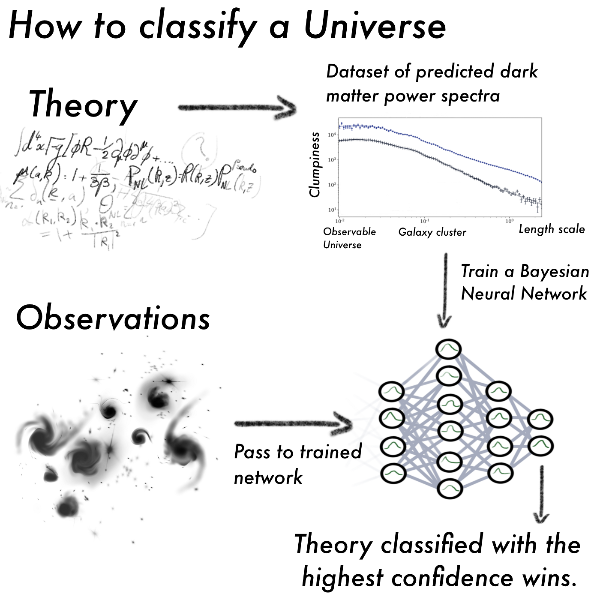
In this paper, we showed that a suitably trained neural network has a great capacity to classify statistical descriptions of the matter content of a Universe in terms of the underlying law of gravity assumed by that Universe. This implies that such a network could be employed on real observational data of the galaxy distribution in our own Universe to help understand our Universe's law of gravity and its cosmology. The network we constructed was called the Bayesian Cosmological Network or BaCoN.
Now, together with scientists in Edinburgh, Italy and Switzerland, we have extended BaCoN, to include additional known physics such as massive neutrino and baryonic effects, as well as improving our modelling to get the best possible classification accuracy out of BaCoN. Within a couple of years, this network could be used to classify real galaxy data coming from the Euclid mission!
Image credit: Joseph Kennedy
03.2024
Lagrangians to Large Scale Structure
In this paper, we developed a mapping between fundamental descriptions of Nature and the statistical description of the Universe's matter structure at large physical scales. The power of this mapping is that it can be used to produce comprehensive and accurate predictions for galaxy observations, setting up astronomical tests of novel and interesting theories of Nature.
Our next goal is to create a neural network emulator based on this map that can then be integrated into suitable data analysis pipelines. This is necessary in order to compare theory and experiment.
Check out the code: ACTio-ReACTio
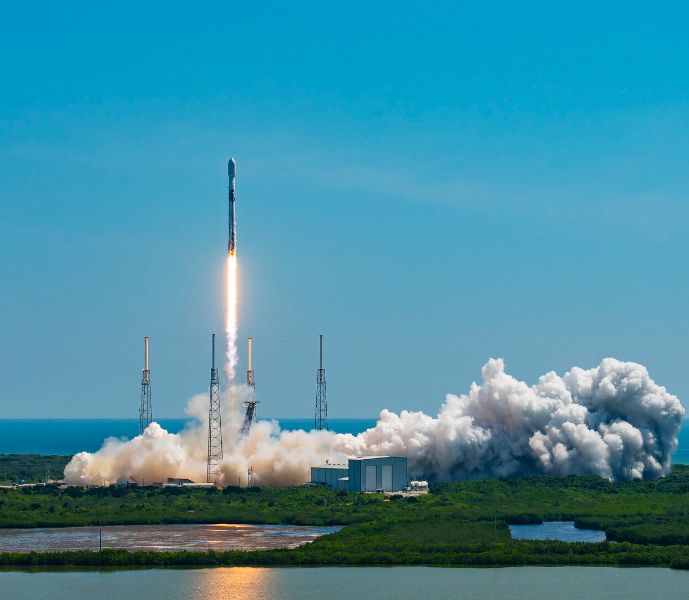
The Euclid Mission
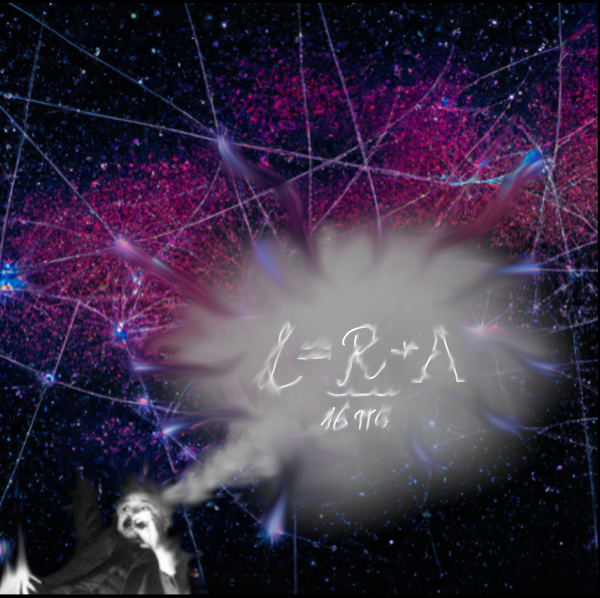
I have been involved in the European Space Agency's space-based Euclid mission since 2018. The mission is charged with investigating the nature of Dark Energy and Dark Matter - the two principal energy components of our Universe based on Einstein's theory of gravity. These mysterious components do not interact with light (hence dark!), and can behave in strange ways. My task has been to develop theoretical and computational tools that will be able to use Euclid data to test alternatives to this Einstein based theory, which may not need all that weird dark stuff!
Update 07.2023
The Euclid satellite launched on board a Space X Falcon 9 rocket on the 1st July 2023 and will observe galaxies over roughly 33% of the sky, and deep into our Universe's past. It will do this for at least 6 years, with the first results expected within a couple of years!
Update 10.2023
My most recent Euclid work provides forecasts for the constraints Euclid can place on alternative theories of gravity.
04.2022